The Benchmark Trap
Why the most reliable AI models for production workflows aren't the ones topping the leaderboards
Most people picking AI models for agentic workflows are optimizing for the wrong thing. They look at the latest benchmark rankings, see which model scored highest on HumanEval or MMLU, and assume that’s what they should deploy. But benchmarks and production reliability have surprisingly little to do with each other.
I’ve been building agentic systems for a while now, and the pattern is consistent: the model that looks best on paper often isn’t the one that actually gets the job done. The reason is that benchmarks measure what’s easy to measure, not what actually matters when you’re orchestrating multiple AI agents in a real workflow.
Take the recent case of GPT-5.4 versus Gemini 3.1 Pro. GPT-5.4 achieves strong benchmark results but “still lags slightly behind Google’s Gemini 3.1 Pro in some tasks” according to formal evaluations. Yet practitioners consistently report that GPT-5.4 feels more reliable for agent-based work. Nathan Lambert describes GPT-5.4 as “more capable of handling diverse, complex tasks reliably, reducing previous frustrations with failures in operations like git commands.”
The picture gets even more complex when you consider models like Anthropic’s Opus, which often demonstrates exceptional reasoning capabilities but with different reliability characteristics than either OpenAI or Google’s offerings. Or Z.ai’s GLM4.7, which despite being less discussed in mainstream benchmarks, has shown remarkable consistency in specific production scenarios that larger models sometimes struggle with.
What’s going on here? The disconnect reveals something important about what benchmarks actually test.
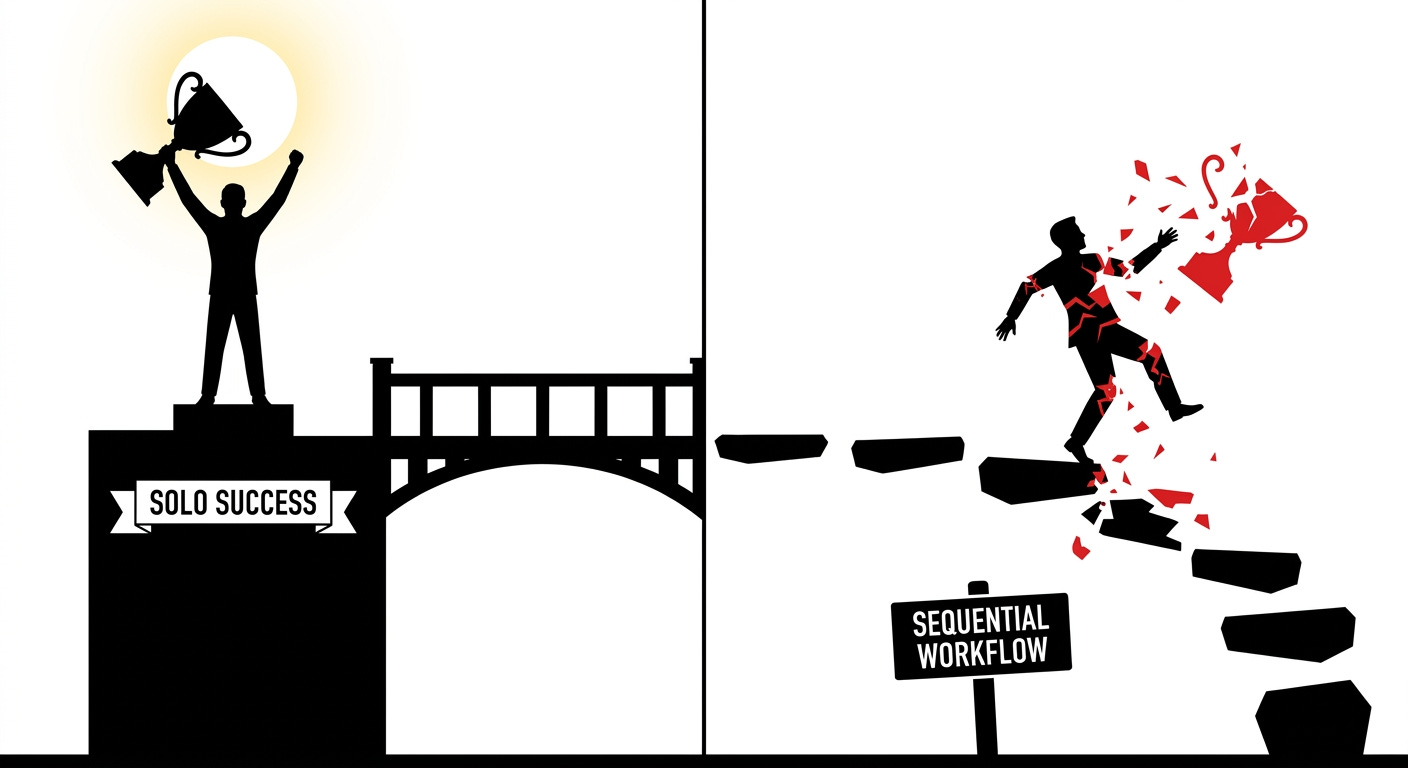
Traditional benchmarks optimize for getting the right answer on well-defined, isolated problems. But agentic workflows aren’t about getting one answer right — they’re about reliably executing a sequence of interdependent tasks without breaking. When an AI agent fails at step 3 of a 10-step process, it doesn’t matter that it would have scored 95% on a reasoning benchmark. The whole workflow is dead.
This is where agentic performance benchmarks become crucial. Frameworks like AgentBench and WebArena specifically test multi-step task completion with tool calling capabilities. Early results from AgentBench show fascinating divergences from traditional benchmark rankings. GPT-5.4 consistently outperforms higher-scoring models on isolated tasks when measured on multi-step workflows requiring tool coordination. Similarly, WebArena’s web navigation challenges reveal that models with strong reasoning scores can still fail catastrophically when required to maintain context across multiple page interactions.
The ToolBench results are particularly telling. When evaluating models on their ability to select appropriate tools and chain multiple API calls, the rankings shift dramatically. Claude Opus, despite not leading traditional benchmarks, shows exceptional performance in tool selection accuracy and error recovery. The benchmark measures not just whether a model can call a function, but whether it can gracefully handle API failures, select alternative tools, and maintain task coherence across multi-step processes.
Even more revealing are the results when using Claude Code and Codex as execution harnesses for multi-step programming tasks. The Berkeley Function-Calling Leaderboard shows that when models are evaluated not just on code generation but on successful execution of multi-step programming workflows with real tool integration, the reliability rankings change substantially. GPT-5.4 shows superior performance in maintaining execution context across complex debugging sessions, while Gemini 3.1 Pro excels at initial code synthesis but struggles with iterative refinement workflows.
This is why Lambert notes that GPT-5.4’s “mechanical, meticulous nature” makes it “better suited for master agents executing complex, specific tasks.” The key word is “meticulous.” Traditional benchmarks don’t measure meticulousness. They measure peak performance on isolated problems.
The reliability patterns vary significantly across models when tested on agentic benchmarks. SWE-Bench results show that Opus tends to be more verbose in its reasoning steps, which correlates with better performance on complex debugging tasks but slower execution on straightforward implementations. GLM4.7, while smaller, often exhibits more predictable failure modes that are easier to engineer around, particularly in tool calling scenarios. Gemini 3.1 Pro excels at certain multimodal agent tasks but may show inconsistency in text-only tool coordination workflows.
In the work we do at Voxdez, I see this play out constantly. Teams will choose the highest-ranked model on traditional benchmarks, deploy it in a multi-agent system, and then spend weeks debugging reliability issues that agentic benchmarks would have caught. The model that scored 2 points higher on MMLU turns out to hallucinate tool calls, or fail to maintain context across longer conversations, or break when you ask it to execute the same task type it just handled perfectly.
The problem is that traditional benchmarks abstract away all the messy details that make or break production systems. They don’t test what happens when an agent needs to recover from a partial failure. They don’t measure how well a model maintains coherent state across a 20-minute conversation with multiple tools. They definitely don’t capture whether a model will reliably follow the specific formatting requirements your downstream systems depend on. This is exactly what agentic benchmarks like TaskBench and AgentGym are designed to address.
But here’s what’s interesting: this isn’t an argument to ignore traditional benchmarks entirely. Models that can’t clear basic capability thresholds won’t suddenly become reliable in production. The issue is treating traditional benchmark rankings as the primary signal rather than using agentic performance benchmarks as the qualifying filter.
Think of it this way. Traditional benchmarks tell you whether a model can do the thing at all. Agentic benchmarks tell you whether it will do the thing consistently in multi-step, tool-integrated contexts. User-reported reliability tells you whether it will work in your specific production environment. For agentic workflows, multi-step consistency matters more than peak performance because one failure can cascade through the entire system.
This creates a different evaluation framework. Instead of asking “which model scores highest on MMLU,” you ask “which model completes the most AgentBench tasks successfully.” Instead of optimizing for the best case on isolated problems, you optimize against workflow failure rates. Instead of measuring what a model can do in isolation, you measure what it won’t do wrong when orchestrating tools and maintaining context.
The cost dynamics make this even more important. GPT-5.4 models “cost more to operate” than alternatives, but if the higher cost gets you reliability that prevents cascade failures, the economics work out. Opus sits in a similar premium tier but offers different reliability characteristics, particularly excelling in tool coordination scenarios. GLM4.7 presents an interesting middle ground, potentially lower costs with solid reliability for specific use cases, as evidenced by its performance on domain-specific agentic benchmarks.
This is exactly the kind of transition we help teams navigate at Voxdez, moving from AI experimentation guided by traditional benchmarks to production deployments guided by agentic performance requirements. The mindset shift is significant: you stop thinking like a researcher comparing models on isolated tasks and start thinking like an engineer building systems that need to work end-to-end.
What does this mean practically? Test the models you’re considering on agentic benchmarks first, then on your actual workflows. Look at AgentBench scores, WebArena results, and ToolBench performance. Include the usual suspects: GPT-5.4, Gemini 3.1 Pro, Opus, but also consider alternatives like GLM4.7 that might better fit your specific reliability and cost profile. Measure task completion rates, error frequencies, and recovery patterns in multi-step scenarios. Pay attention to edge cases and failure modes in tool calling contexts. And weight the experiences of practitioners who are actually running these models in production over the latest traditional leaderboard rankings.
The reality is that you need to build your own evaluation framework that combines insights from agentic benchmarks with your specific use case. No matter how sophisticated the benchmarks become, whether traditional or agentic, they can’t capture whether a model is good for your specific tasks and whether you can reliably predict performance as your software evolves and your prompts change. Creating your own benchmark that incorporates multi-step workflows and tool integration is the most important step in this process.
The best model for your agentic workflow isn’t the one that would win a traditional benchmark competition. It’s the one that will quietly execute multi-step processes, handle tool failures gracefully, and maintain context reliably without breaking in ways that surprise you. Sometimes that’s the traditional benchmark leader. Often it’s the model that performs best on agentic benchmarks and fits your specific operational requirements. But you’ll only know for sure by measuring what matters to you: end-to-end workflow completion, not isolated task performance.